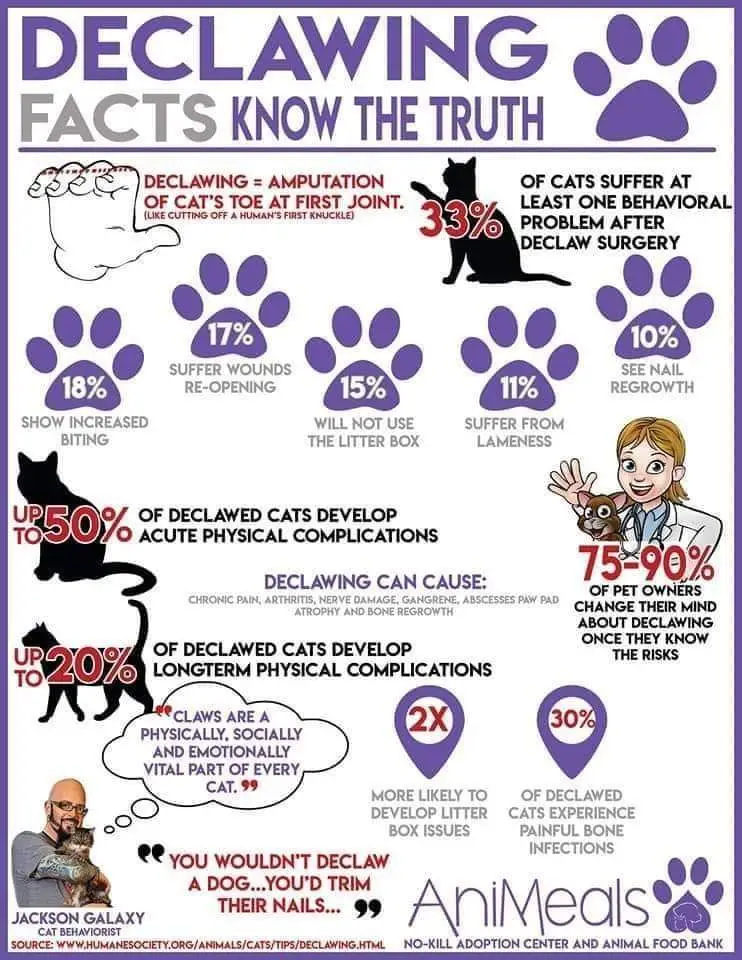
A cat infographic with the facts and figures.
Uncategorized

Declawing: what it is and how it’s done!? Know the Truth

What is declawing? Declawing is a series of bone amputations. Declawing is more accurately described by the term de-knuckling and is not merely the removal of the claws, as the term “declawing” implies. In humans, fingernails grow from the skin, but in animals that hunt prey, the claws grow from the bone; therefore, the last bone is amputated so the claw cannot re-grow. The last bone of each of the ten front toes of a cat’s paw is amputated. Also, the tendons, nerves, and ligaments that enable normal function and movement of the paw are severed. An analogous procedure applied to humans would be cutting off each finger at the last joint. Declawing, also known as onychectomy (än-ik-ek-tō-mē), is a major surgical and potentially crippling procedure that robs an animal of its primary means of defense. Declawed animals may be at increased risk of injury or death, if attacked by other animals. They are deprived of their normal, instinctual behavioral impulses to use their claws to climb, exercise, and mark territory with the scent glands in their paws. Learn more continue reading…

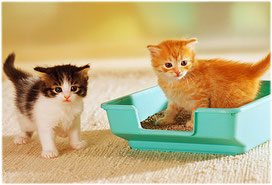
Two kittens, one in litter box.
Uncategorized

Preventing litter box problems

from https://www.humanesociety.org/resources/preventing-litter-box-problems Cats can be finicky about their bathroom habits, so unless you want to be dealing with a regular mess at home, keeping your cat’s litter box up to their standards is very important. The following suggestions should keep your cat from “thinking outside the box.” Boxes & litter How many? The general rule of paw is one litter box for each cat in the home, plus one more. That way none of them will ever be prevented from eliminating in the litter box because it’s already occupied. Litter Box Items on Amazon.com It’s not possible to designate a personal litter box for each cat in your household, as cats may use any litter box that’s available. That means a cat may occasionally refuse to use a litter box after another cat has been in it. In this case, you’ll need to keep all of the litter boxes extremely clean, and you might even need to add additional boxes. However, it’s best not to place all the boxes in one location because your cats will think of them as one big box and ambushing another cat will still be possible. Covered boxes Some people prefer to provide their cats with a covered litter box. While covered boxes can increase privacy and decrease the amount of litter that flies from the box when your cat buries their business, there are some potential downsides. An “out of sight, out of mind†little box is easy to forget about, which may lead to a dirty box with odors trapped inside (which is even less likely to be appealing to your cat). Covered boxes can also be difficult for larger cats to turn around and position themselves in, and may lead to easier ambushes upon exit. Ultimately, if your cat doesn’t like a covered box, they won’t use it. To find out which type your cat prefers, you may want to experiment by offering both types at first. Self-cleaning boxes There are a wide variety of litter boxes available that offer convenience and automation in cleaning your cat’s litter. Buyers beware: some of these features may prevent a cat from wanting to use their litter box, so if your cat is used to a traditional box, it’s best to stick to what they know. Pick of the litter There are several different types of cat litter on the market. The most popular ones are traditional clay litter, scooping/clumping litter, crystal-based/silica gel litter and plant-derived/biodegradable litter. Most cats prefer fine-grained litters, presumably because they have a softer feel. Newer scoopable and “clumping†litter have finer grains than typical clay litter and are very popular because they keep down the odor. But high-quality, dust-free clay litters are fairly small-grained and may be perfectly acceptable to your cat. Once you find a litter your cat likes, stick with it. Switching litters constantly could result in your cat not using the litter box. If your cat has previously been an outdoor cat and prefers dirt, you can keep them out of your houseplants by placing medium-sized rocks on top of the soil in the pots. You can also mix some soil with their regular litter to lure them in. A cat who rejects all types of commercial litters may be quite happy with sand. Many people use scented litter or air freshener to mask litter box odors, but often times, these odors can be offputting to cats. A thin layer of baking soda placed on the bottom of the box will help absorb odors without repelling your cat. Set up Most people tend to place the litter box in an out-of-the-way spot to minimize odor and prevent cat litter from being tracked throughout the house. But if the litter box ends up in the basement next to a creepy appliance or on a cold cement floor, your cat may be less than pleased, so you may have to compromise.  – Keep the litter box in a spot that gives your cat some privacy but is also convenient. If the box is too hard to get to, especially for a kitten or an elderly cat, they just may not use it.  – Avoid placing litter boxes next to noisy or heat-radiating appliances, like the furnace or the washing machine. Noises can make a cat nervous, while heat from a dryer or furnace can magnify the litter box smell, which could make them stay away from the litter box.  – Put the box far away from their food and water bowls. Place at least one litter box on each level of your house. That way your cat has options if access to their primary box is blocked (the basement door is closed or your dinner party has them holed up in the bedroom.) If you have more than one cat, provide litter boxes in several locations so that one cat can’t ambush another cat using the litter box.  – If you keep the litter box in a closet or a bathroom, be sure the door is wedged open from both sides to prevent your cat from being trapped inside or locked out. Depending on the location, you might consider cutting a hole in a closet door and adding a pet door. Cleaning To meet the needs of the most discriminating cat, you should scoop feces out of the litter box daily. How often you actually replace the litter depends on the number of cats you have, the number of litter boxes and the type of litter you use. Twice a week is a general guideline for replacing clay litter, but depending on your circumstances, you may need to replace it every other day or only once a week. If you clean the litter box daily, you might only need to change clumping litter every two to three weeks. If you notice an odor or if much of the litter is wet or clumped, it’s time for a change. Scrub the box every time you change the litter. Use mild

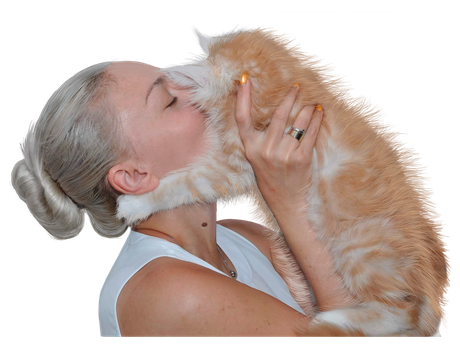
A woman is kissing her cat on the cheek.
Uncategorized

The EuroCoons Difference

If you read our story about how the EuroCoons Maine Coon cattery began, then you know that everything we do comes from a place of love for our Maine Coon cats and kittens!  We brought our first Maine Coon cat, Europa, because we loved the look and personality of these big, wild-looking animals. Two more European Maine Coon kittens (Charles and Alysia) from Ukraine soon joined the family because we were so smitten with our Queen. We became Maine Coon grandparents because our Prince Charles loved Europa so much and couldn’t wait to have kittens. Yes, I know how this sounds, but in fact it’s true, Charles would refuse to mate any other female Maine Coon until we had to make the decision and separate him from Europa. We then started EuroCoons Maine Coon cattery because we loved nurturing our baby coon kittens and placing them in the best homes possible. So what sets our Maine Coon kittens and cats apart from others? Spoiler alert: It’s love. YES, I do realize how corny that sounds but YES, I do truly believe that the love and affection we give our kittens before they leave the cattery makes a huge difference in what amazing Maine Coon cats they grow up to be.  Here are five reasons why: 1. WE TREAT OUR MAINE COON KITTENS NOT AS PETS, BUT AS OUR CHILDREN Our whole world quite literally revolves around our babies. We carefully watch over every single kitten and know when they ate, pooped, slept, played, etc. We don’t miss a moment in our kittens’ development from the moment they are born to the moment they leave the cattery. 2. BECAUSE OF OUR DEVOTED LOVE & CARE, OUR Maine COON CATS HAVE PEOPLE-LIKE PERSONALITIES Our clients rave about the larger-than-life personalities our Maine Coon kittens  have to match their big bodies. They are highly-intelligent, loving, affectionate animals, and each one has a unique personality just like we humans do. Every one of our cats is goofy, friendly, and wants nothing more than to be a devoted member of your family.  3. OUR MAINE COON KITTENS AND CATS EAT COMPLETE RAW DIET WITH HOME-COOKED MEALS INSTEAD OF COMMERCIAL TREATS Yes, seriously. We prepare completely balanced raw and home-cooked meals for our babies, including the best lean cuts of meat and Salmon, Sardines, Rabbit, you name it. This helps them grow into the big, beautiful Maine Coon cats with the healthiest bodies, and  most vibrant coats by the time they leave our home/cattery. 4. OUR KITTENS ARE GIVEN EXPERT Veterinary CARE Not only by us at home, but our kittens and cats are also seen by the licensed veterinarian. You may wonder, what is so special!? The answer is that the clinic comes to us. Yes, we mean everything is done here at the cattery, even spay and neuter surgeries. And absolutely no clinic trips are allowed to protect our most precious cargo. Our Maine Coon kittens are given routine checkups as well as extensive (and expensive) genetic testing to ensure we don’t miss a thing and have healthy kittens and cats. And of course, God forbid, if an emergency happens and a  kitten or cat need hospitalization, regardless of cost, we will do everything we can  (and sometimes can’t) financially to save our babies lives, big or small. We will never put a kitten or a cat down because of high hospitalizations costs. The rest is up to God and Veterinary Specialists. 5. And Finally WE DO noT OVERBREED OUR Maine Coon Kings and Queens All of our cats are bred on schedule. I like to see one litter per 8-12 month from each individual queen. Of course sometimes there are exceptions, when a queen has frequent and prolonged cycles we are forced to breed her ASAP, otherwise she can get Pyometra and dye. Our cats come from the very best European bloodlines with the latest  looks, colors, and patterns. And of course, conformation to Maine Coon breed standard.  Here are a few things we are not: Summary We started this cattery out of love and passion for these majestic animals and that really is what sets us apart. We take great pride in the time and care we put into our kittens and we know every kitten that leaves our home knows what it’s like to be treated like family and will crave that same affection from you and yours. That’s the EuroCoons Maine Coons cattery difference. If you’re interested in learning more about our cattery or inquiring about one of our kittens, please send us an email to kittens@eurocoonsmainecooncattery.com or fill out our contact form.

Fluffy cat lounging on wooden platform.
Uncategorized

Maine Coon Cats Exposed! The Characteristics, The Myths, And The Mystery!

What is it about Maine Coon Cats? Is it their magnificent coat? That amazing tail? Who could miss the super long whiskers? Perhaps it’s their size? Maybe your favorite trait is the lynx-like tufts on their ears? Let’s take a closer look at their unique traits and characteristics to give us some insight. As all Coon lovers know, this is no ordinary cat! read more source & image credit: mainecooncatnation.com

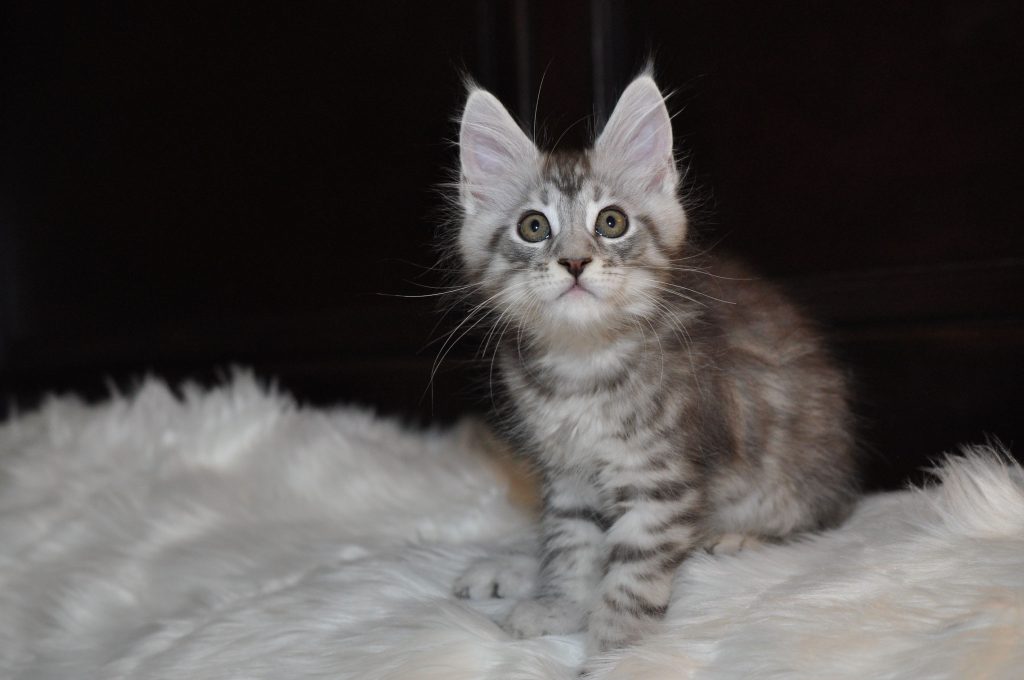
A cat sitting on top of a white blanket.
Uncategorized

What’s the difference between Maine Coon and EuroCoons?

“EuroCoons” Maine Coon! So is this a Maine Coon or EuroCoons? We often get asked this question, but it’s difficult to give a simple answer. So this short article explains the difference between Maine Coons and EuroCoons. To clarify confusion, “EuroCoons” refers to our cattery’s name only, short for European Maine Coons. Eight years ago, when we started our cattery, we were fascinated with European Maine Coons, so, naturally, when we thought of the name for our cattery, the name “EuroCoons” came up instantly. After that, we noticed that people started talking about EuroCoons cats on different platforms and in various groups as it’s a different cat breed. So, at that time, as mentioned above, the name “EuroCoons” was indicative of our cattery’s nature exclusively, short for European Maine Coons, and our cats being bred in Europe. It is not a special breed of cats. The Maine Coon Look Our EuroCoons have many desirable traits, such as a stronger muzzle and chin and tall ears with the Lynx-like tips/brushes. American Maine Coon cats typically lack the sought-after “wild” look that our clients adore. Additionally, our EuroCoons have piercing almond-shaped eyes that add to their exotic appearance.  Maine Coon Size The two breeds have significant differences in size, temperament, and appearance. EuroCoons, at least ours,  are more powerful than their American counterparts, have stockier bodies, and are more muscular. Our Main Coon Cats have wider faces, longer muzzles, and more prominent ears with longer brushes. And of course, our well-known EuroCoons tail for days. Maine Coon Coat The coat of the Maine Coon may sometimes seem longer as a kitten than the EuroCoons coat. Our Maine Coon coats are silky and soft and, in the beginning, not as puffy. The coat of an American Maine Coon is ‘tighter’ in texture than the EuroCoons’ coat. Maine Coon Personality Both kinds are intelligent and make good pets for active people who want a cat that can be a companion for outdoor activities. A Maine Coon is also great around children. Their affectionate and loving nature makes them excellent companions and ideal family pets. We breed our EuroCoons for extra loving, social and intelligent Maine Coon personalities. In Closing The Maine Coon is one of the most recognized cat breeds in the United States. For decades, the American Cat Fanciers Association (CFA) has ranked American Maine Coon as the third most popular cat breed. However, it’s not the only type of coon cat that people are interested in. In fact, as we found out, there are different types of coon cats, and some even argue that the term ‘coon’ is used loosely. So, now we know the difference between a Maine Coon and EuroCoons. Olga Winn Founder and Breeder  EuroCoons Maine Coon Cattery Tags: Maine Coon, EuroCoon vs Maine Coon

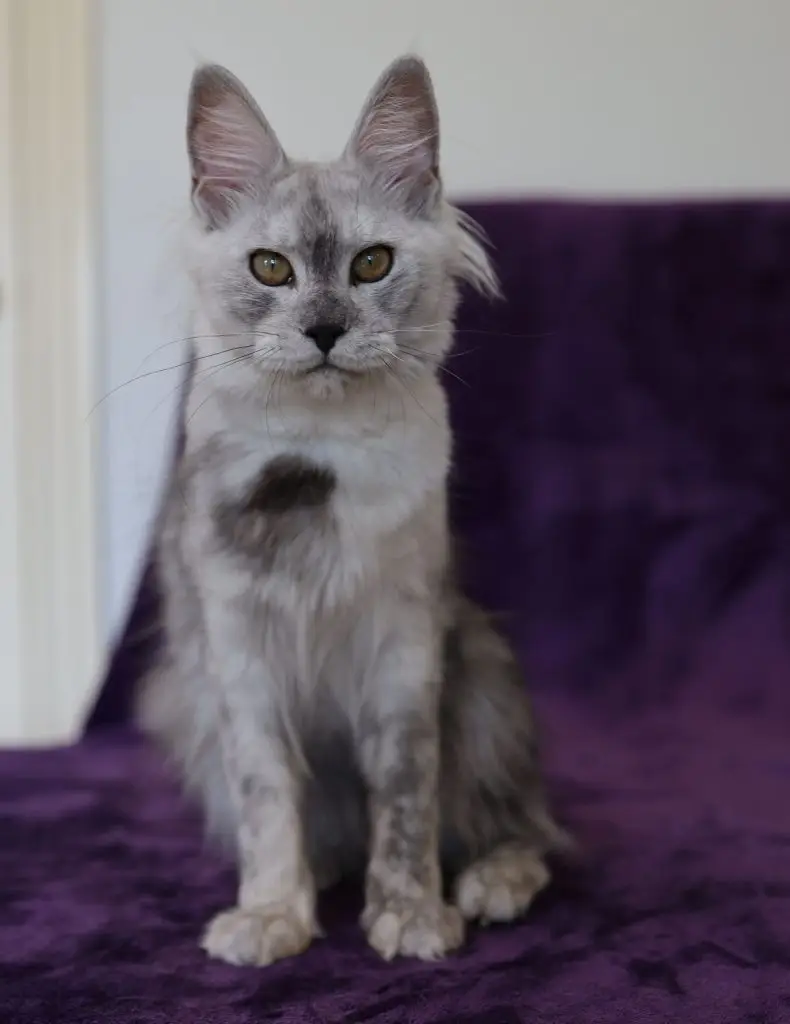
A cat sitting on top of a purple couch.
Uncategorized

Smoke Maine Coon – The Maine Coon cat with the most beautiful fur in the world

Maine Coon Cat is one of the cat breeds with the most beautiful fur .  Smoke Maine Coon cat can produce some of the lightest colored cats in the world and the most desirable. Smoke can range from classic darker smoke to more rare and unique pale full smoke coat making it the most expensive and rare coats of all. A good quality, healthy, of course, and genetically tested strong Pale Full Smoke Maine Coon with the right features can range anywhere from $5000 on the low end to really any number you can think of as they are so rare and the demand is much higher than supply. These cats are truly a work of art. Besides individual and beautiful coats, they are quite a breed, making them ideal indoor pets. Maine Coon cats bond quickly with their new owners and can be trained easily to perform tricks. Furthermore, since these cats are so big, they are known as gentle giants. EuroCoons Maine Coon Cattery specializes in breeding those incredible, healthy, extra-large, unique, and artistic looking, virtually like a painting, full smoke Maine Coon cats. So, if you are looking for a special kind of cat that is large and fluffy, with unique coat color and a pattern second to none, then a EuroCoons Smoke Maine Coon should be first on your list.

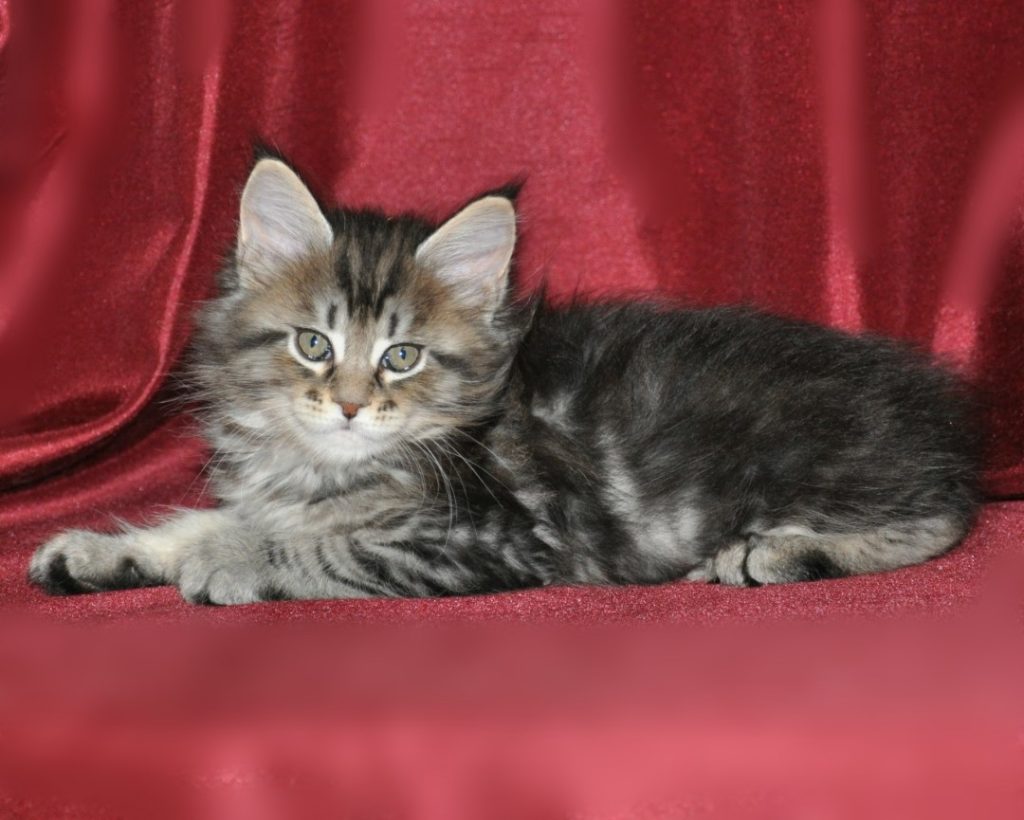
Fluffy kitten lying on red fabric.
Uncategorized

The Feeding Mistake Linked to the Cause of Most Disease – Are You Making It?

Dr. Becker Discusses Raw Food Diet (Part 1) By Dr. Karen Becker   Hi, I’m Dr. Karen Becker, and today we’re discussing my favorite topic: raw food diets for pets. We’re going to discuss some of the myths and truths surrounding raw food diets. But before we get into the good stuff, it’s important to have a foundation of understanding about basic nutrition.   One point that no one is going to argue about is that for optimal health to occur, animals must consume the foods that they were designed to eat. I call this a speciesâ€appropriate diet. So, vegetarian animals must eat vegetation for optimal health. And carnivorous animals must eat fresh whole prey for optimal health. A good place to start with our carnivorous pets is to go back to a dog and cat’s roots prior to the domestication. The domestic dog whose taxonomic name is Canis lupus familiaris is a domesticated form of the gray wolf, which is a member of the Canidae family of the order Carnivora.   Most scientists believe that dogs were domesticated from gray wolves about 15,000 years ago. But DNA analysis published in 1997 suggests that the transformation from wolves to domestic dogs occurred more like 130,000 years ago.  Data suggests dogs first diverged from wolves in East Asia. And then these domesticated dogs quickly migrated throughout the world. Of course, humans began selectively breeding dogs to create animals that suited their needs and their likes.   The earliest evidence of cat domestication is a kitten that was found buried alongside a human approximately 9,500 years ago in Cyprus. Researchers have gained a major insight through DNA testing into the evolution of cats by showing how they migrated to new continents and developed new species as the sea levels rose and fell.   A 2008â€study revealed that lines of descent for all house cats, which are Felis catus, probably came from selfâ€domesticating African wild cats up to 10,000 years ago. And like the domesticated dog, humans began breeding cats to suit their fancy, recognizing over 80 breeds of cats that have been created today by one registry or another. So, there are a lot of different kitty species now that humans have created.  Continue Reading… source: healthypets.mercola.com

Buy Maine Coon Kittens - Purebred Maine Coon Cats & Kittens for Sale | EuroCoons USA
Uncategorized

Adopting a Maine Coon Cat?! The Best Way To Care For Your Maine Coon And How to Keep Your Maine Coon Kitten Happy

Apart from choosing where to buy a Maine Coon cat and discovering the best Maine Coon Kittens for Sale, you should likewise have a mindset to take superior care of your new kitten. This article will guide you in caring for your new Maine Coon. So let’s drill into the depths of it. Maine Coon Cat Diet Let’s start with the basics and the most commonly asked question is, of course, what is the Maine Coon Cat size, and what will my Maine Coon Cat weigh. We like to remind our prospective families that weight and size don’t always go hand in hand. However, they are connected. For example, while Arnold Schwarzenegger and Danny DeVito’s weight may be similar, they certainly do not have the same build. So to answer that question as accurately as possible and according to online sources, in general, the average weight of a Maine Coon is approximately 13 – 18 pounds for males at adult age and 8 – 12 pounds for females. That said, here at EuroCoons Maine Coon Cattery, we have to ensure that all of our clients are ready to meet a giant Maine Coon Cat. Considering following our Maine Coon diet advice, our clients can expect their EuroCoons Maine Coon kitten to reach 18 pounds at least at just one-year-old. Moreover, that is not much different for our female Maine Coon kittens, usually weighing at least 15 pounds by their first birthday.  So what should you feed your Maine Coon kitten to reach their optimal size potential? Again, there are many different opinions on this topic. These opinions range from old-school beliefs such as a dry kibble diet is best. Whether it’s a cheap over-the-counter brand or the most expensive one, they call it “holistic,” I believe. And it couldn’t be further from the truth! Then we have commercial wet “prescription” diets such as your Royal Canin, Science Diet, Purina, and many others that claim to heal or prevent your cat from kidney disease, allergies, and IBS. You name it – those are your large commercial brands that are more focused on their bottom line than on the health of your precious fur baby. The truth is, the ideal food for your cat is, in fact, pretty simple, a species-appropriate diet, which means a complete and balanced raw diet. Yes, I said it – RAW, not cooked, not slightly sauteed, just as nature intended them to eat a mouse or a bird, only appropriately processed and ready to serve. But, of course, nothing is wrong with an occasional mouse (frozen lab-raised only) or a whole prey diet, except it is pretty costly.   You should also include the following things to keep these cats fit, strong, and healthy for many years. Protein is a need for Maine Coon cate to have healthy growth, strong muscle, and ligaments, the carbohydrates supply energy, while vitamins and fat keep them healthy and beautiful shiny coats. Don’t miss to provide your Maine Coon kitten with enough water as they love to drink water, and it’s essential to stay hydrated, but do not forget that with Raw Diet, Maine Coon cats drink less, so no stress. Certain fountains keep them engaged drinkers and provide lots of fun without water splashing over your floors.  Find out what we feed our Maine Coon Cats and Kittens on our Health and Diet Page! Maine Coon Coat Care – Brush Regularly! The Maine Coon breed loves good massaging brushes. You can use a soft massaging brush like Wet Brush for pets and gently stroke your kitty toward the hair growth. Make sure your cat is relaxed and comfortable when you brush them. If they don’t like it, play with them with any toy and try it later. And don’t forget to pay special attention to that famous Maine Coon fluffy tail. Those require a special comb and extremely gentle treatment to preserve that stunning look. Brushing can help your cat in several ways, such as removing dead hair and keeping the coat shiny and free of matted hair. Apart from that, regular brushing keeps skin problems away and your Maine Coon’s stomach hairball free.  Bathing Your Maine Coon The Maine Coon cats love water, but you must accustom them to bathing when you bring them home. Maine Coons prefer the water temperature to be around body temperature, pretty warm, not too chilly or hot. So check the water temperature on the inside of your wrist first. Maine Coon cats should be bathed twice a month. And don’t forget to brush them out before bathing. That will help remove and loosen the hairs that were to shed otherwise and not clog your shower or sink. Maine Coon Play – Involve Them With Activities Maine Coon kittens have a high energy level; you need to help them exert that energy in a non-destructive way. Although they have a stout physique, they still love to play and run. So, you should provide them with plenty of free space and toys. Depending on the size of your home, you can furnish it or pick a designated corner with scratchers, climbers, and other interactive toys. Make the place attractive for them so that they can enjoy themselves there. However, they also anticipate human company, so don’t leave them alone too long, which may make them depressed. If you have to work a typical 8-5 job, please consider adding a furry friend if you do not already own another cat or a dog that enjoys the company of a cat. Are Maine Coon Cats Good House Cats The Maine coon cats generally have a laid-back personality. So, you can raise them indoors. At EuroCoons Maine Coon Cattery, we are strictly against allowing our cats and kittens outdoors to roam free or without proper gear and human supervision. You may choose to take your Maine Coon kitten on the walks on the leash and harness, but keep in mind that a Maine Coon that is acquainted with nature is much more likely to escape outside
A cat sitting on top of a chair.
Uncategorized

What to expect from a Maine Coon kitten?!

Maine Coon kittens are gentle, funny, and goofy. They are intelligent and social. They like playing and listening to noises. They are an old breed admired for their intelligence. So, their popularity has risen in the last decade. To help you with the decision-making process easier, here a number of things that you can expect from a Maine Coon kitten: In Conclusion This article helped to give you a pretty good idea of what to expect from the big cats. Maine Coons kittens are very different from other cat breeds. They will need your attention and care to grow to their full potential. Maine Coons are sweet and gentle cats. They crave love and attention from their human families. But they always want to know that they are the most essential part of your world! Tags: Maine Coon Kitten, What to expect from a Maine Coon kitten, maine coon cat

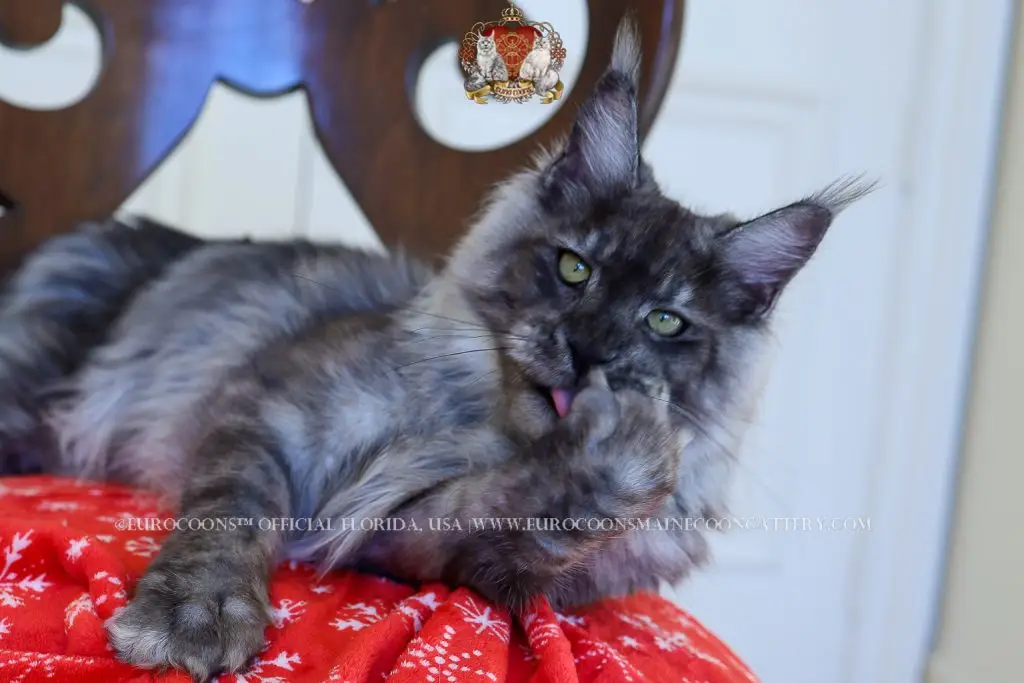
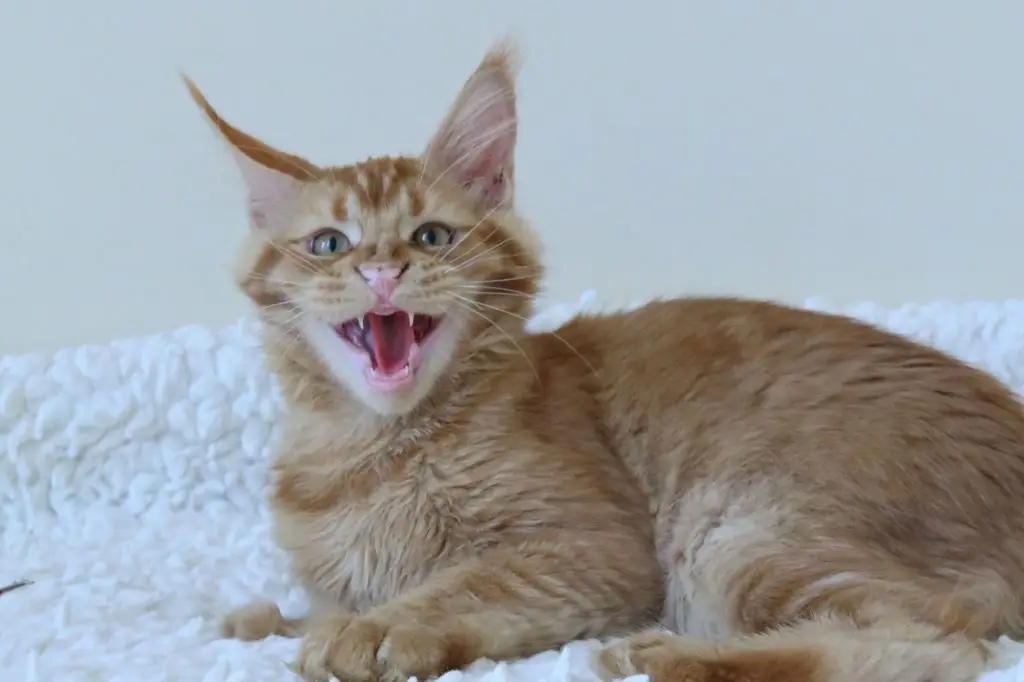
A cat is laying on the ground with its mouth open.
Uncategorized

What Do Maine Coons Eat? And Why Is My Maine Coon Always Hungry?

Maine Coon cats are one of the most famous cat breeds today. They’re goofy yet intelligent and elegant. These majestic mousers can grow up to 40 inches in length and 25 lbs in weight. They’re one of the largest domestic cats. They’re known for their elegant coats and wild European looks. Suppose you wonder why your Maine Coon cat is always hungry and begging for food. In that case, one of the primary reasons is that Maine Coon cats, unlike other cat breeds, are giant and require more calories than average domesticated cats. So if your kitten is always hungry, it’s more likely that he or she needs to get more food. However, there can be multiple other reasons, like poor quality food, i.e., lack of vitamins and minerals in their diet or undiagnosed health issues. Sometimes, Maine Coon owners become worried when their cat demands more food than usual, believing it might be from an underlying disease. Thankfully, this is generally not the case, as your cat might be ravenous for many other reasons. The Maine Coon is undoubtedly the most giant domesticated cat breed. These cats were bred by humans to have large size and health requirements for hundreds of years, starting in the 16th century. Their diet is essential in maintaining their size and health, so most owners feed them wet and dry food. Some families give their cat raw meat, vitamins, and oils to ensure it gets what they would eat in the wild. Even after providing your best, you might observe that your kitten is hungrier than it should be. Making sure why the Maine Coons are always hungry needs more profound attention. Let’s try to understand a few of those reasons. Conclusion Suppose you’re noticing that your cat is becoming more and more hungry. In that case, it’s crucial to identify the reason behind its sudden appetite increase. Once you’ve pinpointed the cause, it’s essential to act and provide your cat with the food it wants and needs. You could be setting your cat up for serious health problems if you don’t. Tags: maine coon diet

Scroll to Top